Spiritual Formation Alphabet: ‘P’

‘P’ is for Practicing His Presence, Part 1

The King of Swing, Benny Goodman, was my hero when I was in 6th grade.  I began in-school clarinet lessons because I wanted to make music like him.  The lessons were once per week and I rarely practiced.  In 7th grade the music teacher graciously accepted me into the band and I still rarely practiced figuring I would learn how to play by merely showing up for class.  I eventually dropped band and the clarinet out of sheer embarrassment – I liked music but I was hopelessly untrained, unpracticed and unmotivated to do what needed to be done.

Practice is important.  We learn to walk by practicing.  We learn to read and swim and drive and make conversation by practicing.  Many things in our lives which are useful, worthwhile and meaningful require practice.  Practice does not necessarily make perfect but practice does make progress.

In Christianity our spiritual health and wellness depend on the life-giving nourishment supplied by God – we call it ‘grace’ because we neither deserve it nor earn it.  God is always with us (believers) and always offering grace.  We simply need to be aware of His presence, open our hearts and receive His gift.  But guess what?  We need to practice being aware, practice opening our hearts and practice receiving what He has to give.  Practice makes progress.

Of course we have spiritual practices.  These practices are also known as spiritual disciplines and please understand the word ‘discipline’ in this context means… practice or exercise.  Think of spiritual practices as tools we use to 1) be aware of His presence, 2) open our hearts, 3) relate personally to God, 4) receive His love and nourishing grace.  We learn how to love Him and others through practice and experience.  Thus we make progress with God, becoming more intimate with Him, growing in His grace, progressing in wisdom and knowledge and understanding of who He is and how He wants us to partner with Him in building His kingdom.

There are personal spiritual practices and corporate ones too.  Spiritual practices rightly engaged in are neither restrictive nor binding – they are ways to relate to God.  None of these are for striving or trying to earn God’s favor.  Spiritual practices are for freedom in Christ.  They are basic components of the rhythm of intimacy with God which feed and nourish our soul/spirit, keeping us open and available for relationship and service – for making good music with our Savior.  And practicing God’s presence is, perhaps, the most vital of all spiritual exercises.

I first learned of practicing His presence from a fellow believer who spoke of reading a classic Christian book about Brother Lawrence’s discovery and explanation of this simple but profound way of relating to God.  Originally I read an older version of the book and struggled with archaic and unusual language.  Yet one phrase captured my attention – having a “continuing conversation” with God.  My heart seemed to know what to do with this challenging exhortation; I was to converse with God, mostly silently under my breath and especially listen to Him in all my waking hours.  I pieced together the truths that God is omnipresent (Jer. 23:24) and “will never leave you nor forsake you” (Hebrews 13:5, Josh. 1:5) along with Paul’s encouragement to “pray without ceasing” (1 Thess. 5:17).  Guessing I had the theory down, I began to move into the practice – easier said than done due to the constant distractions arising from my dullness, my self-centeredness, my disordered desires and the world’s intrusive insistence that I function without God consciousness.

Further help arrived when I read Gregory Boyd’s Present Perfect.  Boyd’s instruction to “remember God’s presence each moment,” to “surrender to God’s presence every moment,” and to “transform every moment… into an act of prayer and worship” further stimulated my desire for this profound relational way with God.  But it was the following encouragement which significantly fed my imagination and sharpened my capacity to practice God’s presence:

“…remind yourself that you are submerged in God’s love (p. 19).  Living in love moment-by-moment is not only the most important thing followers of Jesus are called to do; it encompasses everything followers of Jesus are called to do (p. 111).” 

Gregory Boyd, Present Perfect, Zondervan Publ., 2010

“Submerged in God’s love” and “living in love” seems to be the key for me.  In other words as I live in God’s love much like a fish lives in water, my heart and mind are enveloped with an awareness that God is present and Christ is living His life through me.  This awareness enables me to receive from Him and respond to Him as we partner together to build His kingdom within and without.

It has taken time and effort and practice.  There have been and continue to be failures, fumblings and forgettings.  My consistency at practicing His presence is marked with peaks and valleys, plateaus and troughs.  But I find there is no better or easier way to practice God’s presence – remembering and surrendering – than to focus on His love.  God is love and I am the beloved.  Many mornings before I arise I silently proclaim, much like John the Gospel writer, I am “the disciple whom Jesus loves” (John 13:23).  During the day I frequently repeat a breath prayer confessing the truth, “Abba Father, I live in Your love.”  When I pull on a favorite old sweater or warm coat I mimic Julian of Norwich who discovered, “He [God] is our clothing, who wraps and enfolds us for love, embraces us and shelters us, surrounds us for love” (Showings, as quoted by Jeff Imbach in The Recovery of Love, Fresh Wind Press, 2005).  Saturating my heart with God’s love awakens my awareness of God’s presence.      

“Living in love” is, of course, Apostle Paul’s language.  Boyd refers to Paul’s words, “Therefore be imitators of God, as beloved children, and live in love, as Christ loved us and gave himself up for us, a fragrant offering and sacrifice to God” (Eph. 5:1-2, NRSV).  As I trace the flow of these words an important sequence of events seems evident:  first I live in God’s love and then it is possible for me to love more like Jesus loves.  I accept this sequence as a daily necessity.  My dependence on God is a dependence on His love and my practice of His presence is empowered by His love.

I’ve found poetry-prayer to be helpful to move this relational strategy – living in love and practicing His presence – deeper into my being.

Touch Me

Ted Loder, in Guerrrillas of Grace

Come, Lord Jesus,
startle me
     with you presence, life-sustaining as air,
to open my heart
     to praise you, 
to open my mind
     to attend you,
to open my spirit
     to worship you,
 to open me
     to live my life
          as authentically and boldly
               as you lived yours.
Come, Lord Jesus,
be with me
     in my longing;
come, stay with me
     in my needing;
come, go with me
     in my doing;
come, struggle with me
     in my searching;
come, rejoice with me
     in my loving.

In practicing His presence, experiencing His nearness, knowing His warmth, I am moving deeper from a Master-servant to a Friend-friend relationship with Jesus.  He remains my Master but mysteriously He emphasizes being Friend.  The pure, holy goodness of Jesus’ Friendship is beautiful music of His making, life-giving to my soul.  He is present with me in my longing, my needing, my doing, my searching, my loving.  Wonderfully, Jesus’ presence often brings our “continuing conversation” to silence and we simply enjoy being together.  In our being together my soul is becoming restored and I am enabled for doing.    
Spiritual Formation Alphabet: ‘O’

‘O’ is for Obedience

Building a Better ObedienceThe Psalmist (119:56) delivers a huge challenge to us when he sings, “This is how I spend my life: obeying your commandments.”  His statement sets an extremely high standard and typically we conclude that living such a life of obedience must be difficult.  Won’t we need to exercise great will-power if we are to approach the psalmist’s high standard?  And our practical experience tells us we often fail—we fail to manufacture enough will-power thus we fail to be obedient in so many important ways.

But wait a minute, Jesus said “…my yoke is easy, my load is light” (Matt. 11:30).   How can spending our lives obeying God’s commandments be an “easy” thing?  How can such a load be “light”?

Equipped For ObedienceGod equips us with two ‘tools’ with which we can build into our lives a better obedience.  We find these tools to be surprising, amazing, mysterious and at times even miraculous.  These tools are 1) a promise, and 2) a reward.  Both are provided by the Holy Spirit, the ‘new’ spirit dwelling within our new hearts.

The PromiseAmazingly this is not a promise which we, the believer, must make to God.  Rather this is a promise which God makes to us.  We find it in John 14:15, Jesus’ words to his worried disciples:  “If you love me, you will keep my commandments.”  Yes, we typically read/hear this verse and interpret it as an order from Jesus—he is insisting that we be obedient.  But look/listen more closely, meditate, reflect, chew on this verse until the promise is also evident.

· Jesus states the condition: “If you love me”

· Jesus issues His promise:  “you will keep my commandments”

· In other words He promises if you will truly love Jesus then the Holy Spirit will enable you to be obedient and keep Jesus’ commandments.

Some translations of the bible drop out the words “you will.”  That kind of translation encourages (forces) us to conclude that we must manufacture will-power in order to obey the commandments and obey the word of God.  But when we actually realize the “you will” and hear the promise then we are not on our own to be will-powerful.  As we live-out our love for Jesus the Holy Spirit empowers us to obey.  Jesus does not say exactly how He will fulfill His promise to us, but it is a promise and He is a promise-keeping God.  Let Him do His work – let Him spiritually form us.

Wow! Will-power is not the main factor in our obedience – God’s promise is the main factor. Will-power is required as we work out our salvation (see Phil. 2:12-13) but will-power is only secondary. In this approach, obedience is partly our doing and mostly God’s doing.  Here’s the biblical principle:

“Love is the foundation of all obedience”

Alexander Maclaren

The RewardWhen we work on our relationship with Jesus—when we exercise and express our love for Him, He not only enables us to obey, He also rewards our obedience.  Jesus repeats the promise and explains the reward in John 14:23, “If anyone loves me he will keep my word, and my Father will love him, and we will come to him and make our home with him.” 

· Jesus states the conditions:  “If anyone loves me” and “keep(s) my word”

· Jesus states the promise: “Father will love [you]” – “we will make our home with [you]”

· In other words, we are rewarded with Father God and Jesus becoming even more settled in our souls—we experience more of God’s heart-satisfying and life-changing presence when we love and obey Him.

MotivationGod’s promise and reward serve as the supreme motivation for obedience.  Every time we breathe-out a thought or expression of love for God, we breathe-in more of His reality, more of His presence.  This is a form of practicing His presence and we experience a growing relationship of closeness with the Trinity. This loving, relational activity brings about more restoration of our soul. Yes, we build a better obedience through loving Jesus, trusting His promise and receiving His reward.

Questions

  • In what ways have you been ‘trained’ to assume that will-power is the driving force behind obedience to God?
  • Why is it difficult for many of us to ‘see’ the promise of John 14:15?

Spiritual Formation Alphabet: ‘N’

Narrative:

God obviously prefers ‘story’ since much of the Bible is written in narrative (story) style.  Depending on how you count it, somewhere between two thirds and three fourths of the Scriptures are story – God’s BIG story.  And it is within God’s BIG, redemptive story that we find the little stories of our personal lives taking on meaning and significance.  God is the Author and Master story-teller who is writing us into His BIG narrative – we are characters in His living, dynamic, redemptive drama. 

Awakening.  God is passionate about healing, growing and transforming the stories of our lives.  The restoration of our souls is clearly enhanced when we awaken to the storied-reality of God’s love poured-out to us.  An awakening of this kind happened to me while I meditated on a hope-filled passage, Zephaniah 3:17.

For the Lord your God is living among you. He is a mighty savior. He will take delight in you with gladness. With his love, he will calm all your fears. He will rejoice over you with joyful songs.

Zephaniah 3:17

Initially I reasoned that God Almighty was certainly able to do what Zephaniah proclaimed – it is within the Lord’s capacities to over-look all my sin, all my failings, all my dysfunction and actually delight in me.  I stumbled for a while over the thought of God doing His delighting with “gladness” rather than just because it’s in His job description.  But the next line reassured me: He is a “mighty savior” and as such He is the source of all goodness.  Adding more faith to my reasoning I accepted what the scripture was revealing – from within His abundant goodness God is glad to delight in me.  Characteristically, the more I chewed on the reality of God’s glad-delight love, the more stunned and uplifted I became in the depths of my being – the work of the Holy Spirit in my soul was becoming more evident. 

My meditating on Zeph’s incredible assertion was an on-going process taking place over the course of several days.  With each new day the impact of Abba Father’s love tasted sweeter as the Holy Spirit deepened the experience.  Yet I waited rather doubtfully for something to happen with the final line: “He will rejoice over you with joyful songs.”  This seemed too much, too over the top – perhaps Zephaniah had gone too far.  Was this hyperbole too hyper – God singing because of His joy about me?  After some time I reverted to reason again: “ok, maybe it’s true, maybe God sings and I just can’t hear it or feel it because of numerous doubts and lingering damage from childhood deprivations and soul wounds.”  But really, had I ever experienced any such thing – God singing over me?  I waited, I pondered and then I remembered… a story!

Cruising and Musing.  Benadetto Bagnato was my maternal grandfather.  Born to unknown parents in 1891, he immigrated from Italy to America in 1910.  Benny eventually established a small neighborhood grocery store in Oil City, PA.  Benny and his wife Maria raised seven children, my mother being the youngest.  Benny was a quiet man, spoke broken English and permitted his children to become as American as apple-pie.  He had a winepress in his basement, a large vegetable garden on a terraced hillside and he made a scratch pizza which was to-die-for-tasty.  I knew him to splurge on only one thing: in 1957 he purchased off the show-room floor a two-tone, powder blue and white Chrysler Windsor.  Benny did not put many miles on his car and because he had no garage this gas-guzzler was parked on the street.  I remember Benny standing on the front porch simply starring at the Windsor – a huge, shiny symbol of American identity.  But I do recall one memorable road trip.

That summer of 1957 my parents, my brother and I slid onto the wide bench seats of that monster car and began a three hour drive to visit Aunt Mary, the oldest of Benny’s kids.  Sitting in front between my father who was driving and my stoic grandfather, I was eye-level with the shiny dashboard, transfixed with the radio and wishing someone would tune to KDKA for the broadcast of the Pittsburgh Pirates baseball game.  But Benny preferred we sit quietly and just enjoy the heavy Chrysler float down the road and so we respectfully did.  But after some time a very surprising thing happened – Benny, quiet, reserved, straight-laced Catholic Benny began to sing – in Italian.  He kept the beat by striking his hand on the dashboard and sang what we later learned to be folk songs from his homeland.  Song after song the foreign serenade continued.  This was new territory for all of us – never before had we heard Benny sing.  Goose-bumps arose on my arms.  Only my grandmother knew what the lyrics were about but no one was asking and no one was explaining – we simply listened and absorbed the captivating atmosphere.  Eventually Benny grew quiet and after a few moments spoke in his broken way, “I sing a love song.”  With tears streaming down his cheeks (we had certainly never seen that before) Benny tenderly crooned one last time.  The Chrysler kept cruising and we were left musing about the inner workings of this private man’s heart.  It was a beautiful interlude and we were touched by the unexpected outflow of Benny’s surprising passion. 

Curious Imagination.  With reflection this little family story has become iconographic – symbolic of my journey to experience the meaning of Zephaniah 3:17.  Revisiting Benny’s passionate singing I was originally brought to consider, “What is it like to feel such love, a love which brings joyful tears?”  Lately I have pondered with sanctified imagination, “Did I receive in that Chrysler a foggy-misty glimpse of God rejoicing in song over His faithful children?”  The story now catalyzes in my soul a brighter acceptance of the truth of Zephaniah’s words and energizes a confident assurance that God’s joyful songs are real and on-going.  In fact there are times I ask to hear this marvelous music, much like David asked for God’s blessing in Psalm 143:8, “Let me hear of your unfailing love each morning, for I am trusting you.”  Zephaniah’s prophecy in tandem with Benny’s story continues to grow, in my heart, a joyful sense of being loved by God.  Scripture and story are doing what they were meant to do.

Overflow and Invasion.  God’s redemptive story overflows the Bible and invades our lives.  The Holy Spirit interpenetrates our messy stories and, in so doing, works us into deeper, more intimate, trusting relationship with Himself.  God desires to attach us more securely to the Trinity and to one another, enfolding us into His circle of life.  And His strategy involves using story as a means to this end.  As we become aware of our life narrative and see the various ‘chapters’ of our lives, …as we reflect on and share our stories with attentive, empathetic story-listeners, something more of God’s goodness arises in our hearts and minds.  Current neuroscience research confirms that the story-teller and the story-listener create a secure attachment pattern with one another, simply by sharing their stories.  This kind of healthy attachment – better known as spiritual friendship, fellowship, even discipleship – leads to spiritual maturation, transformation and growth.  Curt Thompson, M.D. explains:

“One of the wonderfully mysterious outcomes of storytelling and listening is their capacity to enable our left and right [brain] modes of processing to integrate.  The left and right brain are integratively woven together in a way that doesn’t happen when someone simply reads or listens to text that invokes logical, linear, right-wrong processing.”

Curt Thompson, Anatomy of The Soul, Tyndale House, 2010

Stories are the best way for us to understand and communicate the experiences of life.  By explaining our life as chapters in a narrative, we see more clearly how our chapters are connected – we realize how choices and consequences are linked together.  Seeing our lives as stories helps us understand our developing character and our growing soul – the deeper aspects of who we are and why we make the choices we do.  Realizing our stories helps us determine in what ways our character is strong and healthy and in what ways we are weak, broken and under-developed.  Revealing our stories helps us uncover where we are in the development of our spirituality (our relationship with God).  When we grasp our stories, we more clearly understand our desires, needs, wants, and dreams.  We become more aware of our wounds and our need for healing, growth and restoration.  Then we can more easily open ourselves to what God wants to do for us, with us and through us. 

A Route for Restoration.  Story-telling and listening are a designated route to our destination called soul restoration:

“This interpersonal interaction [sharing our stories] facilitates the integration of various layers of neural structures and brain systems, which in turn creates new neural networks.  Such an encounter is necessary because we cannot change our stories without simultaneously changing the neural pathways that correlate with those changes.  God is in the business of changing your story from poorer to richer, from harsher to gentler, from rigid to flexible, from sadder to joyful, from shameful to confident and free.  Telling your story to an empathetic listener is one means through which God works.”  (Curt Thompson, ibid)

Curt Thompson, ibid

God designed humans to learn, develop and live largely through the hearing and telling of stories.  Our minds and hearts resonate with story and are stimulated by story.  Many of our memories are stored in our brains as… stories.  Allow the Author of the greatest story ever told to range free and uncluttered in your mind and heart, transforming and re-writing your little story as a part of His overarching narrative of redemption and restoration.  

Spiritual Formation Alphabet: ‘M’

‘M’ is for Meditation

Scripture meditation is the master key unlocking doors within our hearts, giving access and making space for the Holy Spirit to transform our lives in many on-going ways.

Psalm 119 draws us along the way of meditation, attracting us into the process, beckoning our attention and inviting our participation.  Here’s a little taste from the NRSV:

I treasure (have hidden) your word in my heart (v.11), I delight in the way of your decrees (v.14), I will meditate on your precepts (v.15), open my eyes [to] wondrous things (v.18), my soul is consumed with longing for your ordinances (v.20), your servant will meditate on your statutes (v.23), your decrees are my delight (v.24), I will meditate on your wondrous works (v.27), turn my heart to your decrees (v. 36).

Meditation Is.     Meditation is the practice of sustained attention for the benefit of our soul.  To treasure and hide God’s word in the heart is to meditate.  To meditate is to relate to God in a personal, intimate, meaningful way, longing for and delighting in His word so that His life increasingly becomes your life.   Meditation is a relational tool, a way to create emotional and spiritual ‘space’ which allows the Holy Spirit to nurture, heal and mature us.  Meditation brings character transformation and enables our obedience – a deep obedience surpassing simple external conformity – to our loving Father God.

Meditation is inward fellowship, communing with God, listening to Him speak through the words we read and reflect on.  To meditate is to ponder and absorb the life He has for us: it is to ask Him questions, receive His answers, to be cleansed, to accept His forgiveness and to be loved, yes, always to be loved.  God’s tender, gently-strong love finds its way through meditation to nurture us, direct us, correct us and awe us.  To meditate is to slow down and allow the Holy Spirit to personalize the scripture to us.  In this process we become radically attached to Abba Father and restoration of our relationship with Him occurs. 

God is highly motivated to meet with us through meditation – it’s one of His preferred ways of transforming us to be more Christ-like.  To meditate is to communicate with Him, to grow our ability to surrender to His wisdom, to deepen our appreciation for who He is and why He does what He does.  In meditation we learn more intimately how he wants us to ‘be’ and ‘do’ our life-in-Christ. 

Through meditation the written word of God becomes the living word personally addressing us.  Life flows through meditation as Creator God shapes and molds us for His purposes.  Meditation is Mary of Bethany sitting at the Lord’s feet, listening and conversing and absorbing Jesus’ words.  Meditation is a means of grace by which our minds are washed (Eph. 5:25) and our roots absorb the living water needed by our parched souls (Psalm 1:3).

Meditation Is Not.     Scripture study, a vitally important spiritual discipline, is not meditation.  Bible study includes the reading of longer passages, learning the truth about God and life with technical accuracy concerning words, concepts, principles and doctrine.  Scripture study need not be a completely academic affair but it is primarily a left brain activity (logic, sequence, literalness, analysis).  Study is wonderfully engaging as we discover, collect, examine and dissect the details.  Ah, the glorious details!  But ‘study’ is primarily ‘informational’ bible reading and this kind of reading does not readily bring character change. 

Meditation and Reading for Relationship.     Meditation is principally a right brain activity (relationship, emotion, metaphor, synthesis, intuition, aesthetics).  Meditation is conversational and primarily ‘formational’ – it is reading for relationship, relationship with the Author.  Meditation involves us less with exactly what words are ‘written’ and more with exactly how the words are ‘spoken’ – spoken to us by the Holy Spirit.  Indeed during meditation our eyes wondrously function more like ears as we listen to God’s tone, His emphasis and discern the mood and atmosphere of His presence.  Wondrously we sense internally His care filled probing, His invitations, the firmness and tenderness of His love.  This is personal in nature as God graciously makes the descent through the clutter of our head into the issues of our heart, tying good things together and untying the knots and snarls of our soul.  Ah, it is here where we come to deeply know His acceptance, His assurance, His affirmations.  Nothing compares to this kind of personal encounter with our life-giving Lord.

The ‘How’ of Meditation.     If you meditate on just the first 24 verses of Psalm 119 you’ll learn much about how to meditate!  Begin with an attitude of delight and trusting surrender to the Holy Spirit.  As the words direct, praise Him, rejoice in Him and allow yourself to be overwhelmed with desire to be with Him.  Then immerse yourself in a short passage or phrase: read and re-read it again and again.  Ponder and reflect on these few words, softly recite them out-loud, whispering them to your soul.  Listen, wait, listen.  Pray that small portion of scripture to God and ask Him to speak.  Then listen, wait and listen. 

Sustain your attention on the word or phrase or sentence which God whispers back to you.  Do not try to master that particular passage or phrase – rather, allow it to master you.  Allow it to probe you, wash you, strengthen you, encourage you, correct and affirm you.  Allow it to become deeply meaningful.  Even if you don’t know what to do with it, hold it, embrace it, chew on it, gnaw it.  Whisper it out again with a low, throaty rumble much like a lion ‘growls’ as it savors a meaty bone from its prey (Isaiah 31:4).  Treasure it, absorb it and take delight in the fact that God is encountering you, communicating with you, imparting life to you.  Use your sanctified imagination and engage your senses in not only seeing and hearing God’s word, but tasting (Psalm 34) and feeling it, perhaps even smelling the fragrance of  the Spirit’s presence.  These experiences will both develop your soul and disrupt your soul.  God is delighted to meet you and love you in meditation.  He has designed you for this kind of encounter.  Eugene Peterson tells us,

Trust in the power of words to penetrate our lives and create truth and beauty and goodness.  [His word] …enters our souls as food enters our stomachs, spreads through our blood and becomes holiness and love and wisdom.

Eugene H. Peterson, Eat This Book, Eerdmans, 2006

Practice Meditation.     Yes, it takes practice, dedication and discipline. Yes, we may fumble and stumble as we awkwardly develop this spiritual practice. Yes, we must filter out the distractions and prioritize time for these encounters.  But with delighted persistence in meditation we will discover and develop our ability to relate to God, steadily becoming and revealing our true selves in His presence.  Each limited taste of the fruit of meditation will bring deeper satisfaction and stimulate greater desire to return, again and again, to these sacred meetings.  This is devotional intimacy with God on His terms, through His words, under His loving influence.  This is spiritual formation and soul restoration.           

Spiritual Formation Alphabet: ‘L’

‘L’ is for Love. Perhaps you have noticed: love, the awesome, challenging, life-transforming ‘agape’ love practiced by Jesus and offered to His followers is often distorted.  This distorted love accords with and is an out-growth of modernism, the pervasive cultural/philosophical movement which many of us grew up in.  The distortion appeals to the rational side of our mind.  I call it ‘mostly-rational-love.’  Many of us were unknowingly trained to love God and one another in this impoverished way.

Mostly-rational-love is a sterile, manageable sort of thing which flows out of modernism’s preferred certainty of a largely if not wholly ‘objective’ way of living.   While this distorted love rightly emphasizes self-sacrificing action (“love is a verb,” they sternly say), it unfortunately minimizes and often excludes the subjective aspects of agape love.  The distorted version attempts to squeeze out emotion, warmth, intuition and desire – crucial aspects of true agape love.  The result is a barren act of the will with a withering loss of agape’s richness, depth and Christ-power; genuine life transformations rarely happen in this climate.  Mostly-rational-love may also be a symptom of attachment disorders – those festering heart wounds which arise from being poorly loved in our earliest years.  Subsequently, the quality of our love for God and one another is inferior and lack luster.  This kind of love leaves our relationships, our worship, our lives impoverished.        

What’s In Your Stew?   It’s a meat-and-potatoes-only type of Christianity which embraces mostly-rational-love; its emphasis is on living in strength, assertiveness, success, efficiency and accomplishments with minimum mess.  This kind of discipleship – in both theory and practice – misunderstands being, is all about doing and its doing mostly flows from duty rather than desire.  It assumes we ‘love’ someone by simply performing a calculated, self-sacrificing act of the will and that action is carried out in a self-protective manner minimizing any exposure to difficulty and disappointment.  This is loving in a sterile sort of way.  Because there is good truth mixed into this distorted discipleship stew, we may feed on it without noticing it is malnourishing.  However the folks we are attempting to love sense something is missing.  God does too. 

Agape!   Of course Jesus was talking about agape love when He said, “You shall love the Lord your God with all your heart and all your soul and with all your mind” (Matt. 22:37) and “Just as I have loved you, you should love each other” (John 13:34).  Jesus launches us on a life-long journey of  A) learning to love God the way He desires to be loved and B) learning to love one another like Jesus loves us.  This challenging dynamic – learning to agape God and one another – is the primary goal and the central process of our lives and our spiritual formation.

Earlier (see ‘J’ is for Journey) in our study of ‘devotion’ we explored three key facets of agape love: commitment, intimacy and passion – perfectly modeled and faithfully lived by Jesus.  Of these three facets we usually major on ‘commitment’ and minor on ‘intimacy’ and ‘passion.’  But be aware – commitment will keep us together with God and others but it takes both intimacy and passion to draw us close in loving relationship and it’s within relationship that we truly mature as Christians.

“Oh!”   Amazingly God empowers our devotion – to love the way Jesus loves – by indwelling us with the Holy Spirit (Rom. 5:5).  Increasingly as we cooperate with the Spirit our love for God and for one another is infused with these qualities of commitment, intimacy and passion.  “Oh” the warmth and tenderness and caring and compassion and risk and heart-ache and joy and intensity and disappointment and emotions and desires and pain and waiting and experiencing that is involved with intimacy and passion!  “Oh” the subjectivity of it all!  “Oh” the intuitive fabric and functioning of intimacy and passion.  “Oh” that we would be committed to love God and one another intimately and passionately!

Deciding to Love vs. Desiring to LoveBecause we are commanded to love God and one another, we might wrongly think of love as only a ‘duty’ which must be performed in order to avoid punishment or attain some performance standard.  And because loving actions typically require us to ‘serve’ others and ‘sacrifice’ for them, we might mistakenly think of such love as only an act of the will which does not require our emotions to be involved.  Jerry Bridges addresses this problem:

“…we can sometimes give the impression that love doesn’t involve any emotion – that it is entirely an act of the will, or one’s duty, regardless of how one feels.  The Bible does not support such an unbalanced concept of love.  …the Bible uses such expressions as ‘Love one another deeply, from the heart’ (1 Peter 1:22) and ‘Be devoted to one another in brotherly love’ (Romans 12:10).  Some translations choose such words as fervently, fondly, and affectionately in the same passages to describe the love Christians ought to have for one another.

All of these passages indicate that our emotions are involved.  We are to reach out and embrace each other with a deep fervency of spirit….  Obviously, such a fervency of spirit cannot substitute for loving actions, but surely it should accompany them.  We dare not settle for less.

Love is more than a mere act of the will.  We should do more than just decide to do acts of love; we should desire to do them.” 

Jerry Bridges, The Fruitful Life, NavPress, 2006

What Should Love Act and Feel Like?   Paul addresses this question in the famous Love Chapter of 1 Corinthians 13.  While Paul describes love with positive action words (patience, kindness, rejoicing and hopefulness) in verses 4-8, please consider the emotions which should accompany and enrich those action words.   What happens to the quality of these actions if we delete (suppress?) the normal, accompanying emotions?  Answer: quality shrivels! 

An even more complete understanding of love necessitates a consideration of what is not legitimately a part of agape: it is not jealous, not boastful, not rude, not [selfishly] demanding, never gives up, never loses faith.  And notice the emphasis on justice and truth as part of love.  Finally, be aware of Paul’s focus on the test of time for true, agape love – it endures, persists – even through hard, dry seasons.  Agape seems to be the chief of challenges and provokes (and often is driven by) healthy Christ-like emotions while excluding other emotions.  Emotions shape, serve and spring from agape love.

Serving, Sacrificing, Sharing.   Jesus announced His new commandment – agape one another (John 13:34) – but also demonstrated, physically and relationally, what this kind of loving looks like.  Examining the context in which Jesus’ new commandment was spoken helps us see how He intends we live our lives of love:

  • Loving one another looks like ‘service.’  Jesus undressed, wrapped himself in a towel and washed the disciple’s feet (vs. 4-11) as a powerful example.
  • Loving one another looks like ‘sacrifice.’  Jesus understood that the time of his betrayal and sacrificial death was very near (vs. 1-3, 31-33) – He was celebrating the historic Passover and making Himself the Passover Lamb.
  • Loving one another looks like ‘sharing.’  Jesus shared his deep feelings with his disciples as indicated throughout chapter 13 of John.  This was the relational and emotional sharing of Master with disciples; Son of Man with sons of God (dear children).  Jesus was pouring out his life to his disciples a few hours before his blood would also be poured out.  This was/is agape love even in an atmosphere of spiritual war.

Therefore loving one another should increasingly take on these characteristics: we should be serving one another in self-sacrificial ways which include expressions of fond affection, deepening friendship and heart-felt caring.  It’s all about building, sustaining, repairing and growing our relationships, putting love into action in Holy Spirit empowered ways which are infused with desire, emotion, imagination, creativity and long-suffering.  This is the kind of love which cultivates abundant, meaningful life and true character transformation.

Love Passed OverGod’s kind of love has been overflowing with commitment, intimacy and passion from the very beginning – He’s been singing a love song and desires us to join in.  Eugene H. Peterson helps us appreciate, celebrate and appropriate the “exuberances” of love:

“The most pondered act of salvation in Israel was the Exodus.  The event was the kerygmatic center to all of Hebrew life – a glad proclamation of the dynamic action by which it was now possible to live with meaning and in praise before a holy and living God.

Salvation – God doing for us what we cannot do for ourselves, overcoming the powers of bondage, leading through the forces of evil, establishing the people in fact as God’s beloved – was announced in the Feast of Passover as present and personal.

Passover was the concentrated, annual attention that Israel gave to God’s definitive act of saving love.  The [Passover] meal concludes with the reading of the Song of Songs.  No lyrics, ancient or modern, communicate the intimacies and the exuberances of being whole and good in relation to another – that is, of being saved – more convincingly than the Song.” 

Eugene H. Peterson, Five Smooth Stones for Pastoral Work,
Eerdmans Publ., 1980

Jesus, the perfect Passover Lamb, leads us in singing the song of God’s kind of love.  Let’s not pass over the “intimacies and the exuberances” when we love one another; let’s love the way God loves.     

Spiritual Formation Alphabet: ‘K’

‘K’ is for Kenosis. I am privileged to serve on the Inner Healing Prayer Team at my home church, providing a welcoming space for people to receive an intimate form of soul care.  In a private setting the person requesting care/prayer describes their situation and shares their story in an unhurried way.  Our team goal is practically impossible, principally audacious and potentially transformative.  For we seek to facilitate an encounter with the living Christ – an encounter which may bring clarity, growth, freedom, possibly even partial healing to the needy person. We’ve served many people over two decades and here’s what always seems to happen: the team members are humbled, challenged and disrupted in very positive ways.  The person requesting prayer is usually blessed as well!

Self-Emptying.  We team members have learned to ‘empty’ ourselves immediately before a prayer session!  The Holy Spirit seems to minister through us more vigorously and with greater purpose and influence when we confess our human incapacity to truly help one another.  When we acknowledge to God our personal spiritual inadequacy, our insufficiency of wisdom, our meager and distorted knowledge, our deficient experience, our own barren, sinful defectiveness as ministers – when we empty ourselves of our ‘selves’ – God works more freely and typically surprises all of us gathered together in His name.  Our self-emptying is surely an outgrowth of Jesus’ kenosis.

Kenosis.  As a young Christian I often ‘sped-read’ through Paul’s poetic description of Jesus’ self-emptying (kenosis) in Philippians:

“Let the same mind be in you that was in Christ Jesus, who, though he was in the form of God, did not regard equality with God as something to be exploited, but emptied himself, taking the form of a slave, being born in human likeness.  And being found in human form, he humbled himself and became obedient to the point of death – even death on a cross”

(Philippians 2:5-8, NRSV).

As a young lion I was busy crafting the foundation of my faith, intently focused on a spirituality of “ascent” – that is, Richard Rohr’s insightful understanding of the soul’s initial grasping for “ascending, achieving and attaining, …of winning, succeeding, triumphing over ego and obstacles” (The Wild Man’s Journey, St. Anthony Messenger Press, revised ed., 1996).  I was firmly entrenched in the first half of Christian life and unable to apprehend Christ’s mindset of descent: He had “emptied himself” but I could not see the forest for the trees.

Meditative Research.  Eventually with the passing of enough time punctuated with personal struggles and ministry failures I began to seriously wonder about Jesus’ self-emptying.  J. Rodman Williams helped me see Jesus kenosis was a surrender of His original heavenly glory (John 17:5) and riches (2 Cor. 8-9) and not some form of abdication of His divine nature.  Williams notes…

“The self-emptying of Christ, His kenosis, should not be understood to mean that Jesus emptied Himself of …such attributes as omnipotence, omniscience and omnipresence.  …it would be better to say that there was a limitation in their use by Christ in His humanity.”  

Renewal Theology, Vol. 1, Zondervan, 1996

Williams thus supports the truth of Jesus’ simultaneous divine and human natures and His choice to specifically limit His divine attributes.  R. C. Sproul further clarifies Jesus’ kenosis:

“What the whole text of Philippians 2 makes clear is that the emptying was an emptying of divine prerogatives.  Jesus laid aside His privileges.  He voluntarily humbled Himself.  His taking on a human nature did not subtract anything from His divine nature, but cloaked and concealed His glorious and exalted divine nature.”

One Holy Passion, Thomas Nelson Publ., 1987

Our Strength or His?   Was the kenosis (self-emptying) of Philippians chapter 2 only about Jesus or is there something here for us, for our spiritual formation?  I learned early on about the message of servanthood in verses 2-8:  “Let the same mind be in you …take the form of a slave …humble yourself,” i.e. serve one another.  But for years my serving flowed principally out of my own strength and generally out of my own resources.  Such a self-centered approach can readily continue unless I accept the deeper message of Jesus’ kenosis:  when I stand empty before Him, genuinely admitting that without Christ I can do nothing, God will fill me with what is needed for my role in each situation.  Ah, inadequacy and neediness rightly embraced and admitted opens windows for the inflow of grace!  As a spiritual director, author Larry Crabb discovered this gift of emptiness/inadequacy:

“Recently I’ve made a truly liberating discovery.  I am inadequate.  I have learned that an awareness of inadequacy is neither a curse to lift nor a disorder to cure.  It is a gift to be received, a gift that if properly used can make me powerful and strong and clear and wise.”

Shattered Dreams, WaterBrook Press, 2001

And the “proper use” of this paradoxical gift is explained by author Jeff Cook:

“Over and again, God moves toward us.  The movement of the faithful is to make their space ready.  The movement of God is to fill.  In my life and in yours, God’s presence enters only when we are empty enough to receive it.”  

Seven, Zondervan, 2008

Cook’s recipe seems to be ‘open up your inadequacy for the Holy Spirit’s infilling.’

Childlike Qualities.   Returning to my illustration of the prayer team, we have learned to surrender ourselves in childlike humility (Matthew 18:4) so Abba Father can prepare our hearts to properly serve.  We achieve some measure of this humility when we present ourselves to Him in the reality of who and what we are not, along with who and what we really are: His needy ones desiring to help other needy ones.  Expressing our dependency on Him and exercising our trust in Him (Proverbs 3:5) typically enhances our sense of ministering with Him.  Often, awesomely subtle and quietly stunning things begin to happen in the empty spaces we’ve opened for God.  We receive His good gifts, freely given (Matthew 7:11).

Practice Self-Emptying.   We follow Jesus’ own kenotic pattern when we self-empty the self-confidence we would otherwise rely on.  No, I am not referring to a dumping of our self-worth; we remain Abba’s valued children and His partners in kingdom ministry.  But we rest our expectancy on God and cling to Christ’s sufficiency rather than our own – this is the echo of Jesus’ kenosis resounding in our hearts.  This is vital for our spiritual formation and soul restoration.      

Spiritual Formation Alphabet: ‘J’

‘J’ is for Journey. “But seek first the kingdom of God and his righteousness,” (Matt. 6:33, ESV).  I read those words for the first time during a systematic study of the Gospel of Matthew when I was a new believer in Christ.  The word “seek” clearly indicated a quest, a journey was being called for and I understood it to be top priority; first things first.  But I desired clarity:  what should this journey look like?  What exactly does it mean to seek the kingdom of God?  What should I be doing? Would someone please explain this journey?

Drip, Drip, Drip.   Because I can be as slow as a coffee-maker needing decalcification and partially because I lacked good mentors in those early years, it took forever to get a grip on this journey thing.  Awareness and comprehension trickled in as I studied various authors who had written about their perceptions of the Christian journey – in large part these authors became my ‘mentors.’

Frederick Buechner explained the journey to be sacred (1).  R.C. Sproul helped me understand that the quest was a yearning for meaning in life (2).  David Swartz convinced me to be obsessed with the kingdom-oriented search (3).  Richard Rohr imaginatively named the male version of this journey after John the Baptist, the wilderness prophet (4).  The “road map” which I badly needed for the journey was supplied by M. Robert Mulholland (5) and Stanley Grenz convincingly demonstrated that the moral and ethical dimensions of this quest emerge from “…an intimate relationship with this God” and arise as “…our response to God’s demonstration of love, grace and favor toward us” (6). 

I was beginning to have some clarity but the Kingdom of God seemed to encompass so many things and I wanted something like a laser focus – more specificity.  I found John Eldredge to be helpful for he explained the seeking as a heart desire, a “searching for the life we’ve only dreamed of” (7).  Some badly needed synthesis of ideas streamed in when Doug Banister (8) clarified the ‘seeking’ to be a journey of spiritual intimacy with God and Martyn Lloyd-Jones plainly preached this:

“What should we be seeking?  We should always be seeking the Lord Jesus Christ himself, to know him and know his love and to be witnesses for him and to minister to his glory” (9).  

David Benner sharpened the tip of the truth about spiritual intimacy: “The Christian spiritual journey is responding to God’s invitation to personal encounter in love” (10).  And Ruth Barton wrote about the hunger causing us to respond to God’s invitation:

“We are starved for mystery, to know this God as One who is totally Other and to experience reverence in his presence.  We are starved for intimacy, to see and feel and know God in the very cells of our being.  We are starved for rest, to know God beyond what we can do for him.  We are starved for quiet, to hear the sound of sheer silence that is the presence of God himself” (11).    

Journey of Devotion.   This is what I have subsequently named my ‘seeking the Kingdom of God’- it’s my Journey of Devotion.  Two scripture passages fuel my day-by-day journeying:

“There is only one thing worth being concerned about” (Luke 10:42 NLT).

“The one thing I ask of the Lord – the thing I seek most – is to live in the house of the Lord all the days of my life, delighting in the Lord’s perfections and meditating in his Temple.  You have said, ‘Seek my face.”  My heart says to you, ‘Your face, Lord, do I seek’” (Psalm 27:4 and 8, NLT and ESV combined).

The “one thing” which Jesus refers to is Mary of Bethany sitting at His feet and listening, really listening (Luke 10:39, 42).  Mary is, of course, living into the reality of Psalm 27:4 and 8 for she is ‘seeking’ the Lord’s face – this is relational intimacy.  She is delighting in the Lord’s perfections, relating and meditating – deeply processing, seriously considering and absorbing Jesus’ words and way. 

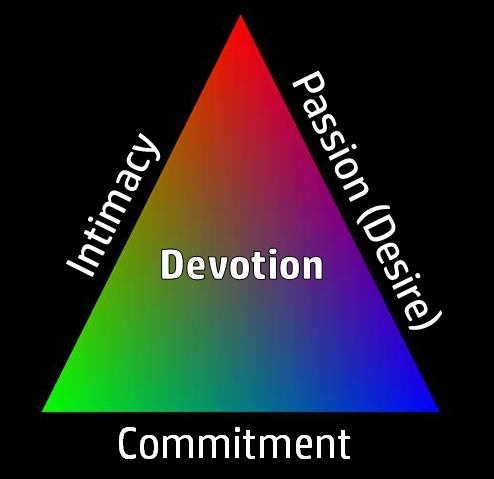
de·vo·tion.    The “one thing” is devotion.  The dictionary defines it as “love, loyalty, or enthusiasm for a person, activity, or cause.”  But devotion to God requires a better explanation and I find the following model very helpful:

Practicing Devotion.     The scriptures reveal something about each major component of devotion (pictured above) and Jesus modeled it perfectly for us – He practiced true devotion to the Father and we are to follow suit.  Allow the Holy Spirit to personally and exponentially expand upon the following explanations of commitment, intimacy and passion (desire). 

Commitment.  This is unconditional loyalty, unfailing faithfulness, dedicated steadfastness. The Father explained His commitment to us this way: “I have loved you with an everlasting love.  With unfailing love I have drawn you to myself” (Jeremiah 31:3) and “My covenant of blessing will never be broken” (Isaiah 54:10).  The Trinity is perfectly committed to us, the Son demonstrated this same commitment to the Father and Mary of Bethany was practicing it with Jesus.  This is to be our commitment to Jesus.

Intimacy.   This is the “seek my face” of Psalm 27.  Intimacy is “…the sharing of closeness, of bonding, of reciprocation.  It is the engulfing of warmth and care.  It is the experiencing of Another.  It is the experience of sharing life together,  …the satisfying of a longing for love and personal significance in the heart of Another” (12). 

Intimacy is knowing and being known at the heart level.  With God it is a sacred kind of closeness.  It is deep, meaningful, fulfilling companionship.  Within this intimacy God accepts us, enjoys us, nurtures us and corrects us.  It is a relentless tenderness which, when we allow it, breaks through our defenses and brings about meaningful connection accompanied by growing feelings of care, security and support.  God perfectly shapes this intimacy for each individual.  It brings life to us. 

Intimacy is far more than just believing and understanding biblical data.  Intimacy means personally experiencing/encountering God.  The Holy Spirit moves us into the reality of close interaction with the written Word of God and Jesus the Living Word (John 1:1).    He longs for us to surrender our fears, faults, weaknesses and all of our brokenness to His care.  He wills deep transformation for us through life-giving intimacy.  The Trinity exists in intimacy, Jesus modeled intimacy with the Father (John 10:14-15), and we are called to relate intimately with Him (John 17:21).     

Passion.    The word ‘passion’ refers to A) God’s desire for us, and B) the intensity of His desire.  He is zealous/jealous for us.  He desires first place in our hearts (Ex. 34:14).

Passion involves more than just God’s emotion but certainly includes His strong emotions.  The Old Testament Hebrews chose specific words to describe facets of His passion: ahab refers to a powerful ‘ardor,’ haphetz indicates his ‘delight,’ ratsah refers to His ‘pleasure’ and hashaq for His ‘desire.’  Meaning, of course, His ardor, delight, pleasure and desire for us, His people!

Passion also speaks of God’s potency or creative power to bring newness, growth and vitality to our lives.  It speaks of His courageous-ness in pouring out love while risking our rebuff.  It speaks of his joyfulness is easing our heavy burdens, turning our mourning into dancing (Psm 30:11) and evoking our wonder with who He is and what He does.

God pursues us passionately, overtakes and uplifts us passionately, passionately rejoices when we do well and passionately aches when we stumble and fall.  He zealously works to conform us to the image of Christ.  He is passionate about His pure desires becoming our desires (Psm. 37:4).  God created desires (longings/yearnings) to be normal, strong, effective motivators of our behavior.  He is motivated to love us passionately.  The Trinity is passionate about One Another, Jesus modeled His passionate desire for the Father (John 2:17), and our devotion to Jesus is to be our greatest passion: “I will put a desire in their hearts to worship me” (Jeremiah 32:40).        

Balanced.     Notice the devotion ‘model’ is an equilateral triangle and our goal is to express a balance of commitment to, intimacy with and passion for Jesus.  I believe the journey of devotion leads into the Kingdom of God, provides for our spiritual formation, soul restoration and links us to every Kingdom purpose God has designed for us.     

References:

1)  Frederick Buechner, The Sacred Journey, HarperOne, 1982

2)  R.C. Sproul, The Hunger for Significance, Regal Books, 1983

3)  David Swartz, The Magnificent Obsession, NavPress, 1990

4)  Richard Rohr, The Wild Man’s Journey, St. Anthony Messenger Press, 1992

5)  M. Robert Mulholland, Invitation to a Journey, IVP, 1993

6)  Stanley Grenz, The Moral Quest, IVP, 1997   

7)  John Eldredge, Journey of Desire, Thomas Nelson Publ., 2000

8)  Doug Banister, Sacred Quest, Zondervan, 2001

9)  Martyn Lloyd-Jones, Joy Unspeakable, Harold Shaw Publ., 1984

10) David G. Benner, Opening to God, IVP Books, 2010

11)  Ruth H. Barton, Invitation to Solitude and Silence, IVP Books, 2010

12)  Elaine Storkey, The Search for Intimacy, Eerdmans, 1995

Spiritual Formation Alphabet: ‘I’

‘I’ is for Imagination

There’s a door in your heart labeled ‘Imagination’ and Jesus often knocks on it.  I believe He prefers this means of entry into the deeper spaces of the heart and our spiritual formation is significantly stagnated, even distorted, without His presence there.  Initially I was both inexperienced with ‘imagination’ and clueless about my ‘heart.’  I needed His persistent knocking simply to awaken the one so that I could ‘see’ the other.  Allow me to share something of these interdependent necessities – imagination and heart – in my journey with God.   

Hearing With Your Imagination.     If we listen closely we hear Jesus knocking on the imagination door via many verses of scripture.  For instance, Hebrews 11:1, “Now faith is the assurance of things hoped for, the conviction of things not seen” (ESV).  To have “assurance for things hoped for” and “conviction of things not seen” requires imagination.  Many of us hear the knocking but assume Jesus is rapping his knuckles on the door labeled ‘Reason & Intellectual Analysis.’  We side-step the imagination and keep opening to ‘faith’ with a different door; so many “things hoped for” and “things not seen” remain inaccessible to us.

And consider Hebrews 13:3, “Remember those who are in prison, as though in prison with them” (ESV).  Most of us can be “as though in prison with them” only by engaging the imagination.  It’s another indication that to live the life Christ would have us live requires an active, supple, responsive imaging ability.    

Some of us respond to this imagination-challenge by saying, “I don’t have much imagination.”  But really, we would not be Christians if we had not imagined God raising us from spiritual death to spiritual life.  There are many great invisibles which we can only know by imagining – the short list includes God Himself, His mercy, His grace and His forgiveness.  Only after we have imagined them as true do we see their observable effects in our lives.  We each have an imagination which provides the ability to realize the reality of God.  It may be stunted but we have an imagination.

Imagination Defined.   It’s our ability to produce mental images and ideas; our ability to see the unseen, believe and trust in reality which is not detectable with the five senses.  No, we are not talking about ‘fantasy’ which deals with the unreal, the illusory.  Rather we mean truth: real stuff both discoverable and apprehensible through the imaging power God has equipped us with.   I especially appreciate Eugene Peterson’s functional explanation: imagination is “our capacity to make connections between heaven and earth, past and present, present and future” (Subversive Spirituality, Eerdmans, 1997).     

For Evil and Good.     The word ‘imagination’ in the Bible appears at first to refer only to a negative, sinful human ability:  Genesis 6:5, “The Lord saw how great the wickedness of the human race had become on the earth, and that every inclination of the thoughts (imagination) of the human heart was only evil all the time” (NIV).  Yet here’s an important explanation:

“But the same word that describes the ability of the human mind to pervert, distort, and ruin a sense of reality is also used in the Bible to describe deep devotion and piety to God.  Isaiah does this in a text beloved by many people:  “You will keep in perfect peace him whose mind is steadfast, because he trusts in you” (Isaiah 26:3, NIV). Here the word translated ‘mind’ is yeser –‘ imagination,’ the same term we found in Genesis 6:5 used for evil imagination.  But in this case Isaiah says that the imagination of the righteous is ‘steadfast.’  …this verse describes imagination that is under discipline.  This kind of imagination is born of confident faith in Yahweh and results in sublime peace – the peace that comes only from God.”  (Imagination: God’s Gift of Wonder, Ronald B. Allen, Multnomah Press, 1985).

Jesus’ Imagination.    Our Creator God loves to use imagination.  Before there was time, Jesus imagined it and brought it into existence.  During creation there was, initially, chaos and then Jesus imagined form and order.  First there was darkness on the face of the waters and He imagined light and caused it to happen.  When it was time for a Savior/Messiah to rescue humanity, the Trinity imagined Jesus as the man.  Jesus imagined water becoming wine.  He imagined two fish and a few loaves of bread feeding thousands.  He imagined dead people walking out of tombs and you and me loving one another; loving even our enemies.  Jesus imagined Himself to be the bread of life, the light of the world, the good shepherd, the vine, the way, the truth and the life, even the resurrection.  Jesus has an awesome imagination – He imagines us having one too.

Seeing My Invisible Heart.     In November 1998 I listened as Dave Hutchins, former Executive Director of Genesis Institute (Spokane, WA) briefly described (knock, knock) the ‘heart’ as the control center of our life.  Dave described the Christian’s heart as “good,” able to be captivated and influenced by God and able to direct our life in Godly ways.  Knock, knock!  Until then I had little interest in my heart, mostly understanding it to be deceitful and desperately sick (Jer. 17:9).  But that, I slowly realized, was the stony, un-regenerated heart.  Actually, I didn’t know what my heart was but I suddenly yearned for it to be captivated by God.  My imagination was awakened and the search for my heart was launched!

Discovery.   I found my heart is new (Ezk. 36:26), is indwelt by the Holy Spirit (Eph. 3:17), needs to be enlarged (Psalm 119:32) and must be united (Psm. 86:11).  These verses served as intriguing, disruptive knocks on the imagination door and my redemptive curiosity was deeply aroused.  Over the next few years I examined, compared and absorbed ‘heart’ information from a variety of theologians, philosophers, pastor/teachers and therapists.  For an insightful and helpful over-view of the spiritual heart, seek out the J.I. Packer and the Jerry Bridges references in the recommended resources below. 

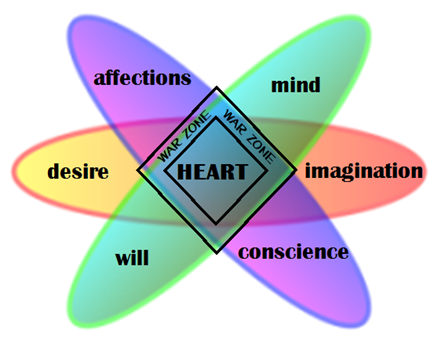
We have a theology of the heart which undergirds the ministry of Genesis Institute including the Spiritual Formation Workshop.  Our heart ‘model’ (below) depicts the central, integrating function of the heart as it incorporates the input and generates the output of the interactive human capacities, one of which is imagination.  This heart activity functions within the context of the ‘war zone’ where the battle rages between the Spirit and the flesh, between Godly desires and self-centered human wants/demands.  With the model in view, can you imagine…

Christ, dwelling in your new heart, desiring to rule and rein over more and more of your mind, will, affections, desires, imagination and conscience, thus further restoring the image of God within you and bringing integration.

Spiritual formation occuring in the war (growth) zone where the battle rages between your flesh (your points of unlikeness and resistance to Christ) and the Holy Spirit. As God’s influence grows, transformation occurs and the heart ‘enlarges.’

Growing Imagination and Heart.     Meditation will do it – the imagination can be engaged and will grow, the heart can be accessed, united (integrated) and enlarged as the Holy Spirit influences you more widely and deeply as you relate to God through meditation.  We’ll probe into more details of Bible meditation/prayer in later posts.  For now, simply imagine yourself as one of the trees written about in Psalm 1:3.  Jesus has His “I Am” statements and we can have ours: “I am a tree…” 

“Happy are those who do not follow the advice of the wicked,  …but their delight is in the law of the Lord and on his law they meditate day and night.  They are like trees planted by streams of water, which yield their fruit in its season and their leaves do not wither” (Psalm 1 vs. 1-3, NRSV).

Imagine your roots – in what kind of soil are your roots embedded (Jer. 17:8; Luke 8:5-8)?  Imagine the water by which you are planted – what kind of water are your roots seeking and drinking (John 4:10)?  Imagine your branches (John 15).  Imagine the fruit you are designed to produce (John 6:44).  Knock, knock! 

We end with this:  “Western theology, particularly since the Reformation has emphasized propositions, a particular way of knowing truth that discounts imagination in favor of reason.  We need to correct the imbalance in our lives and somehow find for ourselves what we weren’t given in school or church.  We need to seize imagination” (Cheryl Forbes, Imagination: Embracing a Theology of Wonder, Multnomah, 1986).  It’s true for me and I imagine it’s true for you.

Recommended Resources

John Flavel, Keeping the Heart, Christian Heritage, 1801 and 2012

H. Wheeler Robinson, The Christian Doctrine of Man, T. & T. Clark, 1926

Thomas R. Kelly, A Testament of Devotion, HarperOne, 1941

Bernard Haring, Christian Renewal in a Changing World, Desclee Co., 1964

Jerry Bridges, The Pursuit of Holiness, NavPress, 1978

Henri J. Nouwen, The Way of the Heart, Ballantine/Random House, 1981

Bernard Haring, Heart of Jesus, Liguori Publ., 1983

Jan Bovenmars, A Biblical Spirituality of The Heart, Alba House, 1991

Michael J. Wilkins, In His Image, NavPress, 1997

Larry Crabb, Connecting, Word Publ., 1997

Neil Anderson and Robert Saucy, The Common Made Holy, Harvest House, 1997

Larry Crabb, The Safest Place on Earth, W Publishing, 1999

Dwight Edwards, Revolution Within, Water Brook Press, 2001

John Eldredge, Wild at Heart, Thomas Nelson, 2001

John Eldredge, Waking the Dead, Thomas Nelson, 2003

J.I. Packer, Praying, IVP, 2006

R. Thomas Ashbrook, Mansions of the Heart, Jossey-Bass, 2009

Henri J. Nouwen, Spiritual Formation, HarperOne, 2010

Dallas Willard, Renovation of the Heart, NavPress, 2012

Dave Hutchins, Core Concepts in Biblical Mentoring – Class Notes, Genesis Institute

Spiritual Formation Alphabet: ‘H’

‘H’ is for Hope

Hope is Essential.   “What breath is to the physical body, hope is to the human spirit.”  That’s what John Claypool writes in The Hopeful Heart, (Morehouse Publ., 2003).    My acceptance of Claypool’s view of ‘hope’ arose as a result of a situation which was for me medically life-threatening and spiritually life-giving.  As a result my soul experienced a fresh infusion of ‘hope,’ something of my character was transformed and the dynamics of ‘hope’ took on a prominence which continues to fuel my ministry today.

Hospital.   In March of 2005 I unexpectedly found myself on a hospital gurney observing the medical staff quickly, efficiently and purposefully preparing me for a heart catheterization and the eventual placement of stents in two of my coronary arteries.  In a matter of hours my self-perception had morphed from “apparently healthy” to “suffering with coronary artery disease.”  Honestly, I felt embarrassed about my arteries – I should have taken better care of them; how could I have let this happen?  Before the anesthesia overwhelmed me I vigilantly watched the team and wondered, “What are You up to in my life, Lord?”  I was hopeful that He was saving me medically but I was unaware of the character change He had in mind through permitting this modest degree of trauma and suffering.  On the spiritual level God was walking with me into the realities of a passage in Romans:

…we rejoice in the hope of the glory of God.  More than that, we rejoice in our sufferings, knowing that suffering produces endurance, and endurance produces character, and character produces hope, and hope does not put us to shame, because God’s love has been poured into our hearts through the Holy Spirit who has been given to us.  (Romans 5:2-5, ESV)

While I wasn’t rejoicing at that critical moment of medical intervention, I later reflected on the incident, rehearsed the vivid scene and realized this:  what I had witnessed in the medical team was active, fervent compassion and their compassion was deeply challenging the relative passivity of my own version of that same virtue.  Over the course of the next few weeks I thankfully recovered and returned to life as normal but with one exception: I now desired to become active, very active, in addressing a life-threatening problem within the Church – far too many souls are not richly experiencing spiritual formation and hopelessness in its various forms haunts people’s hearts. 

I felt re-vitalized.  That aspect of my character known as ‘compassion’ had awakened from its anesthetization – now I wanted to assist the opening of clogged arteries in the spiritual hearts of my brothers and sisters.  I wanted hope, biblical hope to grow in people’s minds and hearts; I wanted souls to be restored.  So I began in the spring of 2005 to pursue spiritual formation in earnest.  Understanding and experiencing hope became central to this quest.

Natural (Human) Hope.   Natural hope is a weak, anemic concept more appropriately described as ‘wishful thinking.’  When we hope with natural hope, we do not have certainty that what we hope for is going to happen.  At best it has the strength of a desire, and at its weakest it is simply a wish which involves crossing our fingers, holding our breath, and bracing for disappointment.

There is nothing essentially sinful about natural hope – it is good and healthy and optimistic to hope that our circumstances improve, that problems may ease, that solutions will appear, that health will improve, that relationships will heal, that understanding will deepen, etc.  The essence of natural hope is to imagine what has not yet come to pass but still is possible.  We wish for/desire what is not yet but could be. 

Supernatural (Holy) Hope.   Supernatural hope rises far above wishing, melds with desire, and transcends them both.  There are two versions of supernatural hope – both versions share the following two-point definition and yet differ in terms of the ‘promise’ which is attached to each version.  Supernatural hope is defined as…

  • a strong desire, confident expectation and patient waiting for the fulfillment of God’s promises
  • a full Christ-centered assurance that God’s promises will be realized

Hope – The Promise of The Glory of God.   The first kind of supernatural ‘hope’ we encounter in Romans chapter 5 is in verse 2.  This is the “hope of the glory of God.”  This hope refers to our final destiny as believers – when we pass away we will be glorified, which means in heaven we will be made whole, perfect.  We will be free of suffering, there will be no more pain, no more sorrow, no more disappointments, no more shame, no more of our own sin.  This is promised and we can be certain of it – just as certain as the reality of the resurrection of Jesus.  We will be like Him in heaven.  That is our first hope – hope of the Glory of God. 

Hope – The Promise of Transformation on Earth.   The second version of ‘hope’ is in verses 4 and 5. This is hope for transformation in the here-and-now.  This is hope of becoming more like Christ as we live daily on earth.

This process of becoming like Jesus began at our conversion and continues as a life-long process of transformation.  This is transformation of our character and our behavior– a process of becoming more whole, more Christ-like.  We are to ‘hope’ for these Christ-like changes in our character (being) and behavior (doing) on a daily basis. We are to desire to be more like Christ and we are to expect these changes will actually occur if we cooperate with God.

Unreasonable and Raw.   Hope is unreasonable because it cannot be figured out with our reasoning abilities.  It requires more than reasoning especially when God takes those things which have caused our broken-heartedness and the things which have held us captive and uses those as the raw material to fashion something new and good.  This reality gives us much to be hopeful about. 

And while the circumstances of our suffering, trials, tribulations and sin are part of the process, the focal point – the place where we are to train our eyes – is not on our circumstances, but on Christ – who He is, what He has done, what He is doing, and what He wants to do both with us and through us.  We are not to deny our circumstances in any way but embrace them as raw materials for God’s workmanship.  God has designed ‘hope’ to help us live within the wideness of His BIG story, rather than the narrowness of our small stories.  In fact, He transforms our stories when we hope. 

My medically life-threatening experience was spiritually life-giving.  Compassion in my soul was activated in a new way as we launched our Spiritual Formation Workshop in the fall of 2008.  The workshop – a ministry formerly hoped for – is now a reality.     

Spiritual Formation Alphabet: ‘G’

‘G’ is for Great Banquet

One recent Sunday I was given opportunity to teach/preach the Great Banquet which is, of course, Luke’s explanation of Jesus’ gracious invitation to salvation (Luke 14:13-24).  I placed minimal emphasis on the Banquet’s past portrayal (Isaiah 25:6-9) and focused only slightly more attention on the future realization of this promised blessing (Revelation 19:6-9).  Rather I decided to linger in the present-moment reality of this stunning invitation to an extraordinary event happening in the midst of our ordinary lives:  we entered into the Great Banquet as a real-time spiritual practice, responding as the expected guests of Jesus Christ.  Let me explain further.

Triple-Tense.     If you are a surrendered Christ-follower then God has already saved you (past tense), is currently saving you (present tense) and shall eventually, finally, completely save you (future tense).  The scriptures verify this triple-tense salvation process.  For example…

Past Tense: “For by grace you have been saved” (Ephesians 2:8)

Present:      “We are… among those who are being saved, the fragrance of Christ” (2 Cor. 2:15)

Future:        “…wearing as a helmet the confidence of our salvation”  (1 Thess. 5:8)


Remembering the past tense of my salvation brings me to grateful rejoicing for what Christ has done in my life.  And I have a confident expectation of the goodness yet to come – I need that protective helmet for I know not what lies ahead.  But most importantly, here am I in the present moment, needing to awaken to the Lord’s on-going salvation activity in my life. 

On my best days I desire to keep current with the Lord, to stay in-step with the Holy Spirit, to be sensitive and responsive, open so that His desires may become my heart desires – that’s spiritual formation.  On bad days, especially when discouraged, I slouch along in the past tense, coasting in something less than contentment and flirting with complacency – that’s deformation.  Fortunately I have learned not to stay in that stall, not to remain stuck in my past salvation, unresponsively rusting away like an old clunker.  The Great Banquet is happening – I must awaken and respond to the present-tense invitation for restoration. 

Guest List.     So Jesus continues to invite the poor, the crippled, the blind and the lame.  That’s us.  He’s intentionally inviting you and me to His glorious feast because He loves us and can glorify Himself so powerfully through our restoration.  He knows the ones most aware of their own brokenness are also most open to His love.  So he invites us, indeed, He compels us – He is passionate in His pursuit and persistent in His persuasion.  If we will only listen and respond and receive.

In which category do you find yourself today?  Impoverished spiritually?  Crippled emotionally?  Lame relationally?  We’re often so blind we see neither these applications nor the implications?  Yet God calls us to include us.  In Isaiah 55 He calls us the thirsty ones, the ones who buy food which does not satisfy our souls.  He also calls those of us who have no money and cannot buy.  Yep, that’s us.  We’re included.

As a Spiritual Practice.     I have, at times, set a single place-setting on our dining room table, envisioning it as my reserved place at the on-going Great Banquet and in response to Jesus’ invitation I have brought something of my brokenness to my place at the table.  Typically I write it – the thing currently crippling me, the issue of my impoverishment, my lameness, my blindness – I write it on a 3×5 card and place the card on the plate.  I know that I and my brokenness have been invited, we are expected and welcomed.  I surrender myself to the scriptural image of the Banquet and to the on-going reality of the Lord’s invitation.  So I leave it on the plate and await an exchange.  I wait to see how My Savior chooses to feed my hunger, quench my thirst, heal my lameness, restore my vision.  So that’s my response.  It’s another surrender.  It’s an opening of my heart for whatever transformation God chooses to do at His Banquet, at His invitation, for my present-tense salvation.

Belonging In Real-Time.     On that Sunday morning the worship team sang ‘Come to The Table’ as a group of women enthusiastically set a banquet table with fine china and fancy glass-ware.  Tall candles were lit and wine glasses were filled – the imagery and symbolism were rich and inviting.   Luke’s words from that former time were read and became Jesus’ words in real-time as we entered into the spiritual practice of the Great Banquet.  We were a motley bunch, so impoverished, so crippled, so blind, so lame yet so blessed.  Blessed because every time we come to this Banquet we feel the belonging-ness of being included.  Every time we come to the Banquet the lies which say, “You don’t belong – you’re too broken, too crippled, you’re not enough” – those lies get weaker and our belonging-ness grows stronger. 

Have you been too busy and missed too many Banquets?  Receive the invitation and respond.  Jesus is expecting you.